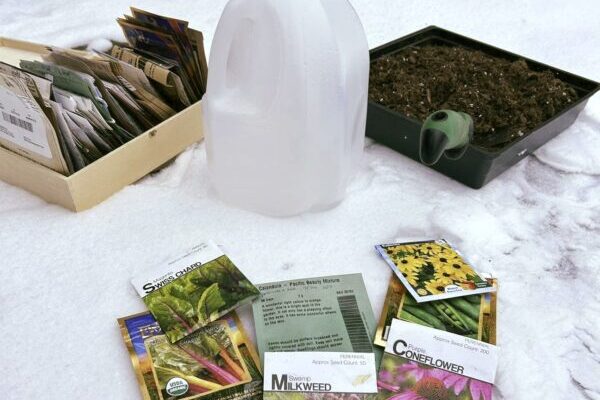
You missed the fall window, but your milk jugs aren’t ready for the recycling bin just yet.
Every gardener has done it. You stacked up the milk jugs in November, fully intending to sow them in December, and somewhere between the holidays and the cold snap, February arrived and you hadn’t sown a single seed. Now it’s March or April, the catalogs are dog-eared, and you’re wondering: is it too late for winter sowing?
The answer, reassuringly, is: it depends, and for more seeds than you might think, the answer is no, it’s not too late. Spring sowing in winter-sow containers is a legitimate technique, not a consolation prize. The key is understanding what those cold weeks were actually doing for your seeds, and which ones genuinely need them.
What stratification is actually doing
When seeds require cold stratification, they’re waiting for a biochemical signal that winter has passed and it’s safe to germinate. Sustained cold and moisture break down germination inhibitors in the seed coat and trigger hormonal changes that allow the embryo to wake up. In nature, this process plays out across several months of winter, but “several months” is the outside number, not the minimum.
Many seeds that gardeners treat as requiring 60 to 90 days of cold will germinate just fine with 30 days, or even two weeks, if the conditions are right: consistently moist, consistently cold (roughly 33 to 40°F), and uninterrupted. A mild spell followed by a hard freeze is not the same as a steady cold period. What matters is accumulated time at the right temperature, not the date on the calendar.
Late winter and early spring in western New York can still deliver several weeks of reliable cold before the ground warms, which means a milk jug set out in late February or March is not wasted effort. It’s abbreviated stratification, and for many species, that’s enough.
Seeds that do well with a short or no stratification window
Some plants are remarkably flexible about the cold they need. Others have been selectively bred for easier germination. And a few, the annuals and tender perennials, need no cold at all and simply benefit from the consistent moisture and gradual hardening-off that winter sowing containers provide.
| Seed | Cold needed | Spring sowing verdict |
|---|---|---|
| Echinacea (coneflower) | 30 to 60 days | Good; often germinates well with 4 to 6 weeks of cold |
| Rudbeckia (black-eyed Susan) | Optional | Excellent; germinates without stratification |
| Lobelia cardinalis | 60 to 90 days | Good; shorter cold still improves germination rates |
| Monarda (bee balm) | 30 days | Excellent; often forgiving of abbreviated cold |
| Aquilegia (columbine) | 30 days | Excellent; light cold stratification is sufficient |
| Larkspur (annual) | Prefers cold | Excellent; sow in early spring, cold weather helps |
| Snapdragons | None | Excellent; thrives in cool spring conditions |
| Poppies (annual and perennial) | Prefers cold | Excellent; direct-sow cold lovers in early spring |
| Spinach | None | Excellent; germinates in near-freezing soil, frost tolerant |
| Kale | None | Excellent; cool weather improves flavor; very frost hardy |
| Arugula | None | Excellent; sprouts fast, tastes best in cool weather |
| Swiss chard | None | Excellent; handles light frost once established |
| Mâche (corn salad) | None | Excellent; one of the most cold-tolerant salad greens |
| Lettuce (butterhead and looseleaf) | None | Excellent; prefers cool conditions; shade helpful in May |
| Baptisia (wild indigo) | 60 to 90 days | Fair; may germinate this year with short cold, or may wait until next season |
| Asclepias (milkweed) | 30 to 60 days | Fair; worth trying, but inconsistent without full cold period |
| Penstemon | 30 to 60 days | Fair; some species are more flexible than others |
| Trillium | 60 to 90+ days (warm then cold) | Skip; needs double dormancy, wait for fall sowing |
| Bloodroot | 90 to 120 days cold | Skip; won’t cooperate with a short spring window |
The case for spring milk jugs regardless
Even for seeds that don’t strictly need cold, the winter-sowing container is a useful tool in spring. The jug creates a miniature greenhouse effect, warming in the day and cooling at night, that mimics ideal germination conditions without any effort from you. Seedlings that sprout in a jug are already hardened off by the time you transplant them, skipping the laborious indoor-to-outdoor acclimatization process.
For cool-season annuals like poppies, larkspur, and snapdragons, a late-February or March milk jug sowing can actually outperform an indoor start: the seedlings don’t get leggy, they don’t need grow lights, and they’re ready to transplant as soon as the soil is workable, sometimes earlier than anything started under fluorescent tubes in January.
Winter-hardy leafy vegetables are equally at home in a spring milk jug. Spinach, kale, Swiss chard, and mâche all germinate readily in cool conditions and can handle light frost once established. Arugula is particularly obliging; it sprouts fast, grows quickly, and actually tastes better when it matures in cool weather rather than summer heat. Lettuce varieties labeled “butterhead” or “looseleaf” also perform well, though they appreciate a little shade as temperatures climb in May. Starting these in jugs in late February or March gives you a head start of several weeks over direct sowing, with none of the fussiness of indoor starts.
Setting up your spring jugs
The method is identical to fall sowing, with one adjustment: leave the tape off, or use a loose tape that allows the lid to open slightly on warm days. In March and April, temperatures inside a sealed jug can spike high enough to cook germinating seedlings on a sunny afternoon. You want warmth, not heat. A few small holes punched near the top help regulate temperature as days lengthen.
Otherwise: cut the jug four inches from the bottom, add drainage holes, fill with moistened seed-starting mix to within an inch of the cut, sow at the depth the packet recommends, label clearly (permanent marker on the jug itself, not a paper label), and tape or clip the top loosely back on. Set in a spot that gets morning sun and afternoon shade; the east side of the house is ideal.
Managing expectations
Be honest with yourself about which seeds are long shots. If a native wildflower packet says it needs 90 days of cold stratification and you’re setting it out in late March in Orchard Park, where you might get four to six weeks of reliable cold at best, germination this season is unlikely. That’s not failure; that’s the seed doing what seeds do. Sow them anyway, mark the jug, and let nature decide the timeline.
For everything else, the coneflowers, the columbines, the bee balms, the snapdragons, the kale, the arugula, a spring milk jug is a perfectly sensible way to get seeds in the ground without heating up the house or crowding the dining room table with trays. Sometimes the best gardening advice is the simplest, a reminder that came up at our club workshop with Becky Overton: grab the packet, fill the jug, and see what comes up. Western New York springs have a way of staying cool long enough to make it work.