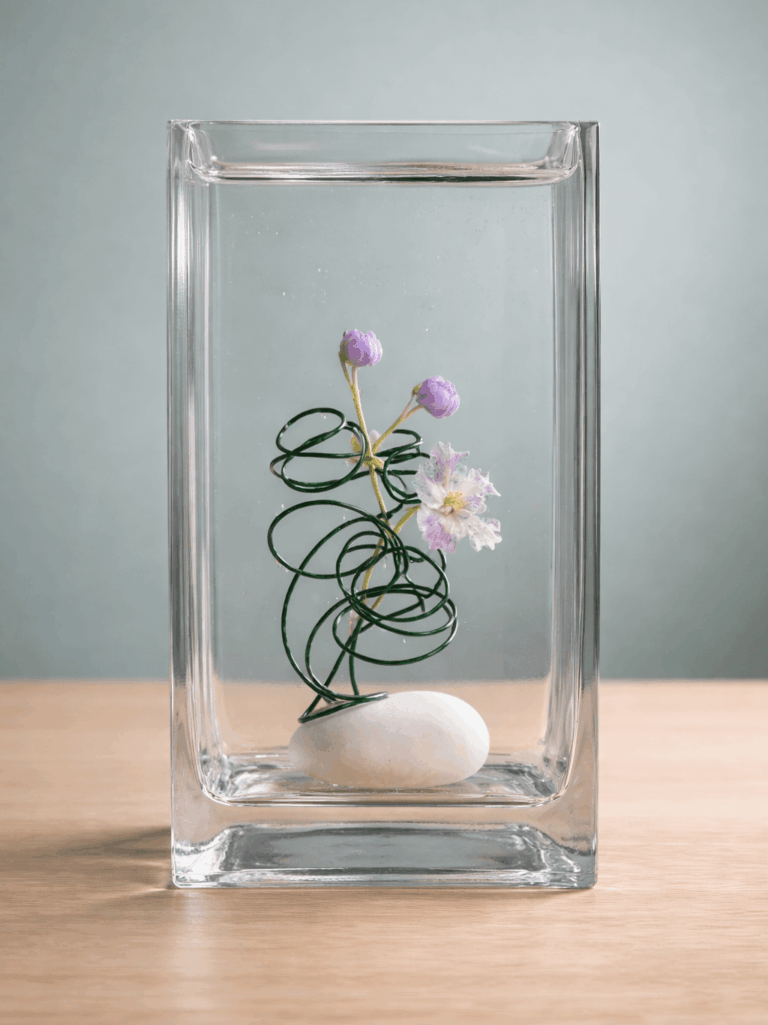
Welcoming Spring
An Ikebana Workshop with Ikebana International Rochester Chapter 53
April 2026
Last week, a few of our members had the pleasure of attending a workshop in Rochester hosted by Ikebana International Chapter 53. The session was led by Saskia Eller, a Sensei Master of the Ohara School, and centered on a beautiful and meditative lesson: Welcoming Spring through the Hana-isho Tall Vase Rising Form.
What Is Hana-isho?
For new students of Ohara Ikebana, Hana-isho is typically the first arrangement style taught, divided into Basic and Advanced categories, with the Basic form including the Rising Form and the Inclining Form. Mastering Hana-isho lays the groundwork before moving on to Classical Ikebana.
The basic philosophy of the Ohara School is to observe nature well and emphasize the seasonal qualities, growth process, and the beauty of natural environments.
The Lesson: Rising Up Toward the Sun
Sensei Eller guided participants to think about what happens in nature this time of year: new plants push up through the soil as warmth and light return. In the Tall Vase Rising Form, you, the arranger, embody the sunshine. Your materials lean upward and forward, reaching toward you and toward the viewer.
A modern tall vase, ceramic, glass, or even one crafted from PVC pipe, is the right container for this style. A shoulder at the vase opening is especially helpful for beginners learning to anchor their stems.
Working with Stems
Water, described as the most important element, reminds us that it is the essence of life. From there, attention turns to the plant materials: two main stems establish the foundation and determine the size of the entire arrangement, while the remaining stems act as supporting fillers.
The principal stem (shushi) should stand roughly three times the height of the container, with one third positioned inside the vase and two thirds visible above, setting the scale and organizing everything around it. The guest stem (kyaku) is shorter and plays a supporting role without drawing attention away from the principal. When assessing a stem, the technique is to look from tip to base, ignoring any natural curves, and imagine a straight line. Cleaning the stem accentuates that line. The goal, as Sensei Eller put it, is to improve upon nature, not change it.
Working with Flowers
To secure a stem inside the vase, slice the base and insert a bamboo skewer cut to size perpendicular to the stem, which prevents it from rolling. Choose three flowers that complement your main materials. Sensei Eller introduced a framework that will stay with you: the prettiest, most perfect bloom is Today’s flower, it faces upward and leans 45 degrees toward the viewer. A fully open flower is Yesterday’s flower. A bud is Tomorrow’s flower. Together they represent the future, present, and past, and create a quiet sense of time passing within a single arrangement. Filler stems add depth and draw the eye back into the composition.
A Contemplative Practice
Participants also learned that Ikebana is not only about design, but about quiet observation and thoughtful presentation. The padded mat beneath your tools keeps noise from interrupting the meditative work, clippers rest on it when not in use. A presentation board or mat beneath the finished arrangement completes the composition, framing it as the intentional work of art it is.
Ikebana is both an art form and a way of seeing the natural world with greater care and intention.
Our members came away inspired and are looking forward to continuing their study.